How to Gain Real Privacy on Ethereum?
Ethereum is the foundation of decentralized finance, but it was never designed with privacy as a priority. Every transaction, token balance, and protocol interaction is publicly visible on-chain.
As on-chain analytics become more advanced and global crypto regulations continue to tighten, this transparency is turning into a growing risk for users who value financial discretion.
This raises an important question: how can users gain real privacy on Ethereum without giving up self-custody, DeFi access, liquidity, or network security?
The answer lies in zero-knowledge privacy layers, and this is exactly the direction HB Wallet is moving toward. Privacy is no longer optional; it is becoming a core expectation for modern wallets.

The Privacy Problem With Standard Ethereum Transactions
Ethereum’s transparency comes with clear trade-offs. Wallet balances are fully public, DeFi positions can be tracked and analyzed, and transactions can be linked across multiple protocols.
Once a wallet is associated with a real-world identity, the entire transaction history becomes permanently traceable. This exposure makes users vulnerable to profiling, MEV strategies, targeted attacks, and unwanted scrutiny.
Zero-knowledge technology addresses this problem by allowing transactions to be validated without revealing sensitive information. Instead of exposing the sender, receiver, amount, and token type, the blockchain only verifies that the transaction is valid and that funds are not double-spent.
This preserves privacy while maintaining Ethereum’s trustless security model.
How Kohaku and Railgun Enable Privacy on Ethereum
Through Kohaku integration, wallets can adopt the Railgun privacy layer, a set of on-chain smart contracts deployed on Ethereum and compatible EVM chains such as Arbitrum and Polygon.
This architecture allows wallets to offer private transactions and private DeFi interactions while remaining fully on Ethereum.
HB Wallet is actively moving toward this model, with privacy positioned as a major upcoming feature rather than a secondary add-on.
Private 0zk Addresses With No New Seed Phrase
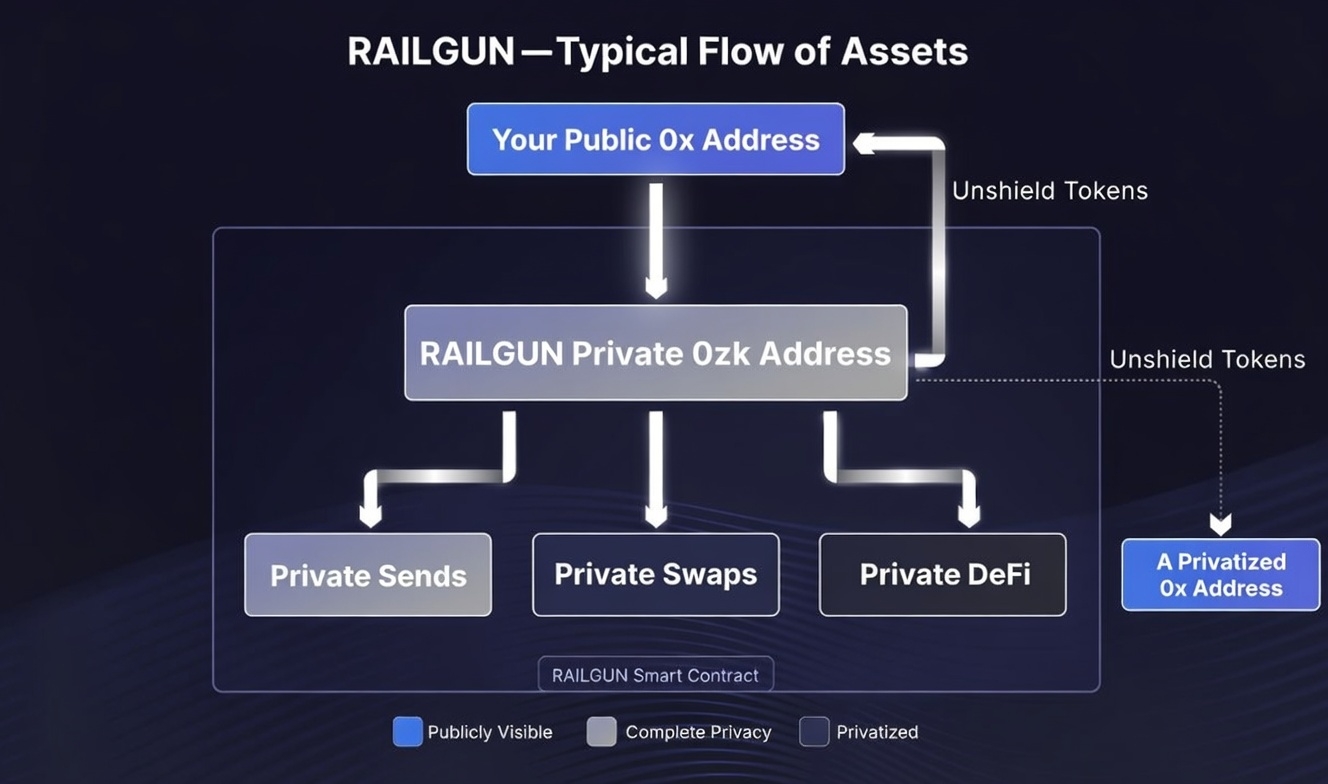
When privacy is enabled, the wallet locally generates a private address known as a 0zk address.
This address is prefixed with 0zk…, uses Bech32m encoding, and is derived from the same private keys as the user’s standard Ethereum 0x address.
No additional seed phrase is required. Crucially, the 0zk address is never published on-chain and remains entirely local, ensuring that user identity is not exposed.
Shielding Assets Into a Private Balance
To enter private mode, users shield assets from their public 0x address into the Railgun smart contracts.
On-chain, this appears only as a contract interaction with an entry fee and no visible recipient or future transaction linkability.
Behind the scenes, the assets move into a shielded private balance associated with the user’s 0zk address.
Using DeFi Privately on Ethereum
Once assets are shielded, users can interact with Ethereum in full privacy.
They can send assets privately to other 0zk addresses, trade on decentralized exchanges such as Uniswap through Railgun integrations, and interact with DeFi protocols for lending, borrowing, and staking.
Throughout these activities, transaction details such as sender, receiver, amount, and token type remain hidden from public block explorers.
What On-Chain Private Transactions Look Like
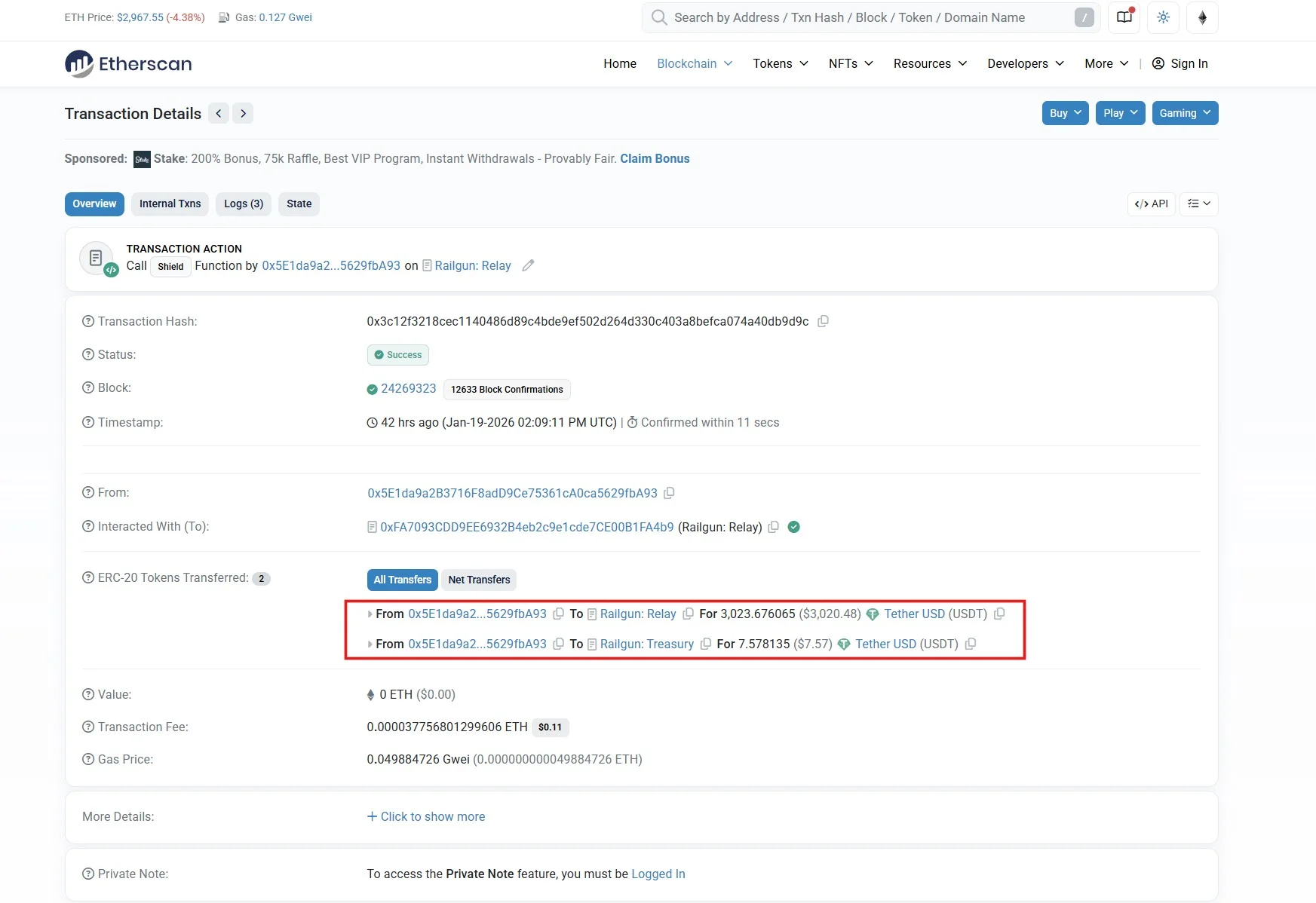
On Etherscan
From an on-chain perspective, private transactions look very different from standard Ethereum transfers.
Instead of readable transaction data, the blockchain records only encrypted commitments representing private balances and nullifiers that prevent double spending.
To the public, these transactions appear simply as interactions with the Railgun contract, with no meaningful financial information exposed.
Privacy Without Sacrificing Security or Liquidity
This privacy model does not require leaving Ethereum. Users continue to benefit from Ethereum’s security guarantees, deep liquidity, and mature DeFi ecosystem, but without broadcasting their entire financial history to the public.

Why HB Wallet Is Making Privacy a Core Feature
As privacy becomes a defining trend in the crypto industry, HB Wallet is aligning itself with this shift by moving toward native zero-knowledge privacy support.
This approach enables the wallet to protect users by default, support private transfers and private DeFi usage, preserve full self-custody, and remain fully compatible with Ethereum’s infrastructure.
Privacy is becoming a central pillar of HB Wallet’s roadmap and a key differentiator for next-generation wallets.
Ethereum privacy is no longer experimental. With zero-knowledge layers like Railgun and wallet-level integrations through Kohaku, users can now achieve private transactions, private DeFi interactions, and seamless self-custody within the Ethereum ecosystem.
As wallets like HB Wallet embrace this direction, privacy is set to become a standard feature rather than an exception.
The future of Ethereum wallets is not only multi-chain. It is private by default.
>> Is Bitcoin Dead? <<
>> Is Ethereum Dead? <<